
Ordering & care
Can One Tablecloth Size Cover Your Banquet Table Inventory?
Compare finished cloth-size ranges across your banquet tables to decide which linens can share stock and which need a separate size.
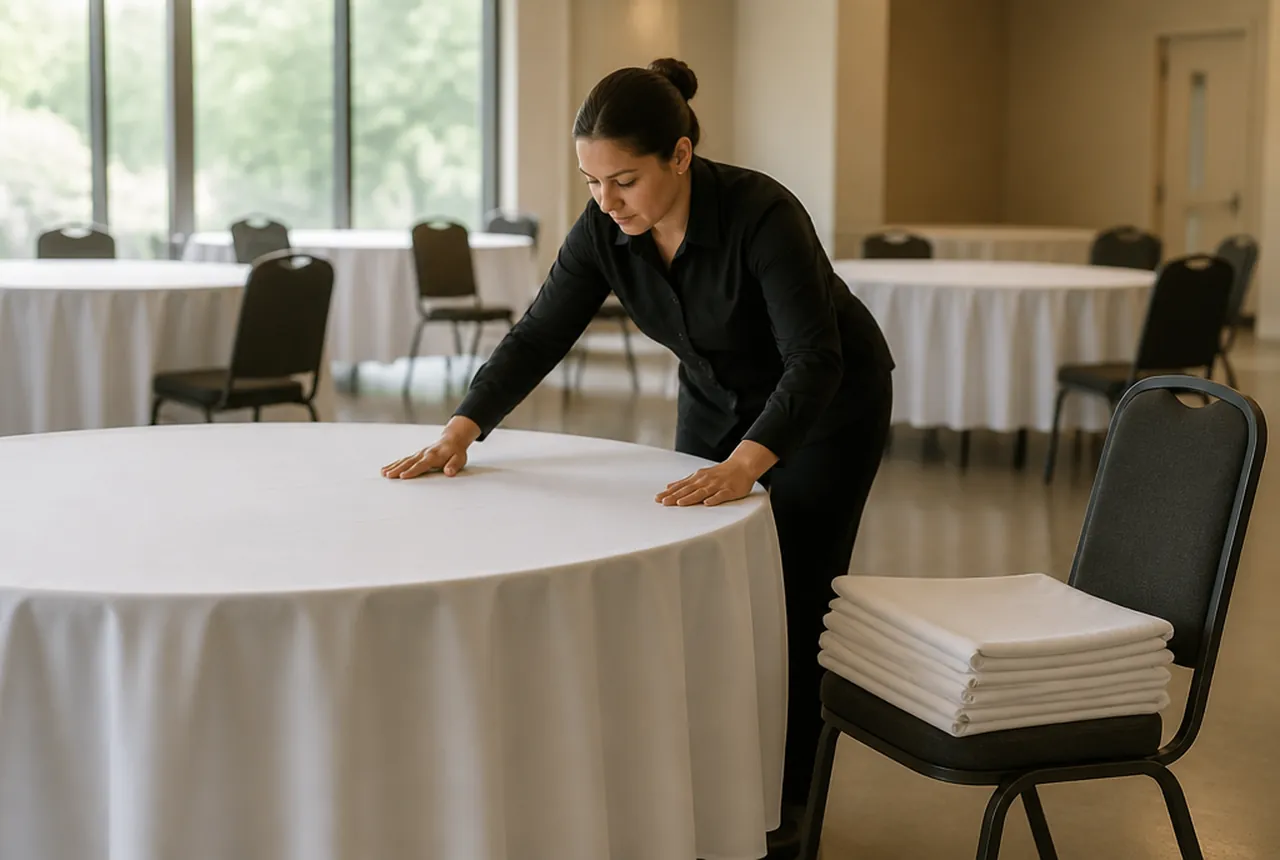
You have two sizes of round table and a shelf of linens that staff keep sorting before every event. One cloth size would make that shelf simpler. It might also leave a short drop on the larger table and a much longer one on the smaller table. Before you combine the stock, work out whether a shared size can produce the result you want on both.
The useful comparison is a range of acceptable finished cloth sizes for each table. Where those ranges overlap, you have a candidate for shared stock. Where they don't, buying a larger cloth won't make the differences disappear. It moves the problem to another table.
Set the drop you will accept on each setup
Measure the actual tabletop, then decide the shortest and longest drop you will consider for that setup. Drop is the distance the cloth hangs below the tabletop edge. Keep the measurements in one unit and distinguish dining tables from buffet, registration, and other service tables.
Use a cloth or sample to review the proposed result with the real chairs and service arrangement. Check guests approaching and leaving, staff working at the edge, and any fitted clips or other accessories. A preferred appearance doesn't settle whether the cloth works in use. Keep access requirements subject to the venue's normal review.
The textile manufacturer and distributor Venus Group's table-linen buying guide explains sizing from the tabletop dimensions and desired drop. It also distinguishes matching shapes from decorative combinations that drape unevenly. Its suggested drop lengths are choices described by that supplier, rather than requirements for your venue. Set your own range from the setup you have reviewed.
For the calculations below, the cloth is centered, lies flat on the top, and has the same basic shape as the table. Skirts, stretch covers, overlays, and cloths arranged asymmetrically need their own fit check.
Compare round tables using finished diameter
For a centered round cloth on a round table:
Drop = (finished cloth diameter − tabletop diameter) ÷ 2.
To work toward a purchase size, reverse it:
Smallest cloth diameter = tabletop diameter + 2 × shortest accepted drop.
Largest cloth diameter = tabletop diameter + 2 × longest accepted drop.
Consider an illustrative venue with 60-inch and 72-inch round tops. Suppose the venue has chosen to evaluate drops from 12 to 18 inches on both. Those drop limits are assumptions for this example, not comfort, access, or service standards.
| Tabletop | Smallest finished cloth diameter | Largest finished cloth diameter |
|---|---|---|
| 60-inch round | 60 + 2 × 12 = 84 inches | 60 + 2 × 18 = 96 inches |
| 72-inch round | 72 + 2 × 12 = 96 inches | 72 + 2 × 18 = 108 inches |
The ranges meet at 96 inches. A finished 96-inch round cloth would give an 18-inch drop on the smaller top and a 12-inch drop on the larger one. That is a candidate to investigate with the linen supplier and a sample.
It is also a narrow result: the overlap is a single diameter. A cloth that finishes smaller would fall below the example's minimum on the 72-inch table; one that finishes larger would exceed its maximum on the 60-inch table. Ask what finished dimensions and tolerances the supplier can provide, and check the cloth under the intended laundry process. Don't turn the arithmetic into an order approval when the actual cloth dimensions remain unknown.
If the venue instead wants exactly the same 15-inch drop on both tables, it needs finished diameters of 90 and 102 inches respectively. One centered round cloth cannot give the same drop on two different tabletop diameters.
Check both directions on rectangular tables
These calculations describe the drop at the straight edges. Inspect the corners, floor clearance, and movement around a dressed sample too; the edge arithmetic alone cannot approve the complete cloth.
Rectangular cloths need two separate comparisons. The width determines the side drop; the length determines the end drop. Write the dimensions as length and width on both the table and cloth records, so a supplier's ordering convention doesn't reverse them.
For each direction, the same calculation applies:
Accepted finished cloth range = table dimension + twice the accepted drop range.
Suppose two illustrative dining tables measure 72 by 30 inches and 96 by 30 inches. Again, use a chosen drop range of 12 to 18 inches on every edge.
| Tabletop | Accepted cloth length | Accepted cloth width |
|---|---|---|
| 72 by 30 inches | 96 to 108 inches | 54 to 66 inches |
| 96 by 30 inches | 120 to 132 inches | 54 to 66 inches |
The width ranges match, but the length ranges don't overlap. A single rectangular size cannot satisfy all four drop limits on both tables under these assumptions.
For example, a finished 108-by-60-inch cloth gives 18-inch end drops and 15-inch side drops on the shorter table. On the longer table, the side drops remain 15 inches, but the end drops become 6 inches. A familiar cloth width can hide the mismatch at the ends.
The 6-foot table guide shows how to check one cloth against one table. This comparison answers the inventory question across several tables. Repeat it for each shape and function you want to combine before choosing the stocked sizes.
Separate a size label from a usable cloth
When you request pricing, tell the linen supplier that the fit calculation uses finished dimensions in the condition in which staff will set the tables. Ask whether the quoted dimensions are nominal, supplied finished dimensions, or another stated measurement, and how the recommended laundry process affects the fit they can confirm.
Give the laundry team the proposed material and instructions before approving a sample. Use the supplier's permitted process, then measure and fit the sample as agreed. Don't apply a shrinkage percentage borrowed from another textile or wash method. A new unprocessed sample and the cloth returned for event use may need different measurement records.
Inspect retained stock too. Record its measured dimensions and usable condition, rather than assuming every cloth with the same label still belongs in the same fit group. Keep a cloth with an unresolved dimension or condition out of the available count until the issue is settled.
Choose shared stock where the whole setup works
For each proposed shared size, list the table types it can serve and the resulting drops. Attach the sample result, finished-dimension basis, and laundry instructions. A cloth size that passes on dining rounds may still need a separate decision for an exposed buffet or a table with a different height or fitted equipment.
If the ranges don't overlap, keep separate sizes or revisit the chosen setups. Change a drop limit only after reviewing the new result; don't widen it solely to make the spreadsheet accept a cheaper stock plan. If you do accept different drops, show them on the event setup record so staff know which appearance belongs to which table.
Then count cloths against the actual schedule, including concurrent events and stock unavailable while being laundered. Keep that quantity decision separate from the size decision. Sharing a size may make stock usable in more places, but it doesn't let one cloth cover two tables at once.
Add the selected cloth size to each table group on your event furniture plan, beside the actual table dimensions. Staff can then pull a known fit from storage, and the next buyer can see why some table types share a linen size while others have their own.