
Sizes & materials
Portable Dance Floor Kits: Panels, Edges and Carts
Compare a portable dance floor kit by panel area, edge pieces, corners and carts. Work through an expansion example before ordering extra panels.
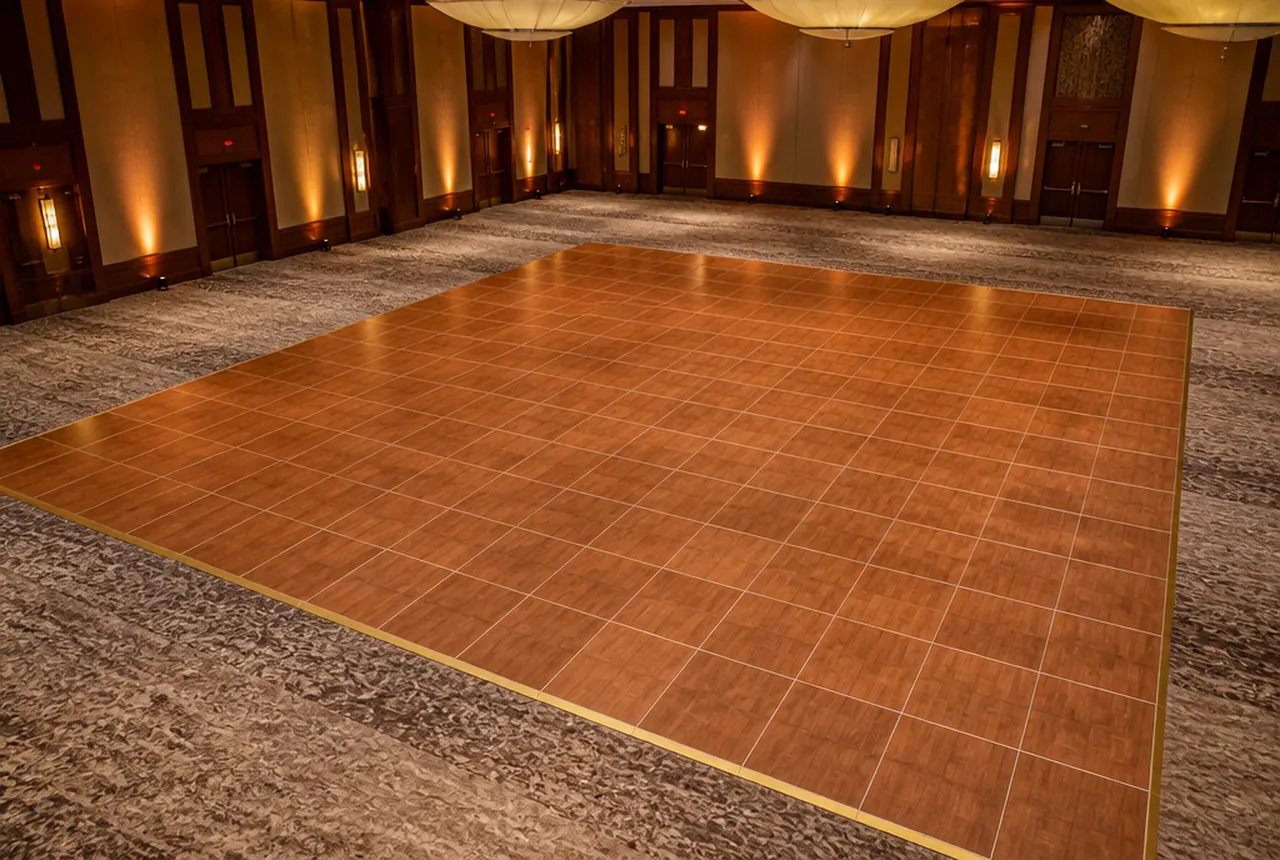
Price a portable dance floor as a complete system: panels, perimeter pieces, handling equipment and the tools its instructions require. The panel area is a useful starting measurement, but the buying decision also depends on the shape you intend to build and how the complete set will travel back to storage.
That matters when expanding a floor you already own. Four extra panels may complete the larger surface while leaving you short of edging or needing another cart. Compare the complete configurations before treating the panel difference as your shopping list.
Start with a panel grid for each arrangement
Choose the floor arrangements your venue needs to offer, using the reviewed event plan. Write the panel module beside each drawing. A floor built from 4-foot squares has different purchasing increments from one built from another module size.
For a worked example, a 16-by-24-foot panel rectangle built from 4-foot squares is four panels across and six long. That requires 24 panels and provides 384 square feet of panel surface:
4 × 6 = 24 panels; 16 × 24 = 384 square feet.
Extending that rectangle to 16 by 28 feet makes it four panels across and seven long. It requires 28 panels and provides 448 square feet. The increase is four panels, or 64 square feet. Those calculations describe the panel rectangle. Obtain the assembled outside dimensions, including the selected perimeter ramps, before placing it on the room plan.
Keep the room's seating, service routes and other event functions in the comparison. The event floor-plan guide explains how to reserve their active working areas. Panel arithmetic does not establish permitted occupancy, an accessible route or the number of people who can dance comfortably.
Compare the kit rows, not just the area
MityLite's Magnattach product information provides a useful manufacturer-specific example. Its panels measure 4 feet by 4 feet, and its named kits include panels, edge ramps, corners and carts.
| Listed Magnattach kit | Panels | Listed edge pieces | Included carts |
|---|---|---|---|
| 16 × 24 feet | 24 | 16 | 1 |
| 16 × 28 feet | 28 | 18 | 2 |
| 20 × 20 feet | 25 | 16 | 1 |
The manufacturer's brochure gives the same kit counts and lists corners among the included components. Have the quotation identify corners separately so an edge-piece total is not mistaken for the complete perimeter package.
The first two rows show why an expansion needs a component check. The larger configuration adds four panels and two listed edge pieces, while the included cart count rises from one to two. The 20-by-20-foot row shows a different arrangement with 25 panels and one cart. MityLite lists a capacity of up to 25 panels for its Magnattach cart.
Use those rows to ask about the specific system offered. Another manufacturer's panel size, edge design and cart arrangement may produce different quantities. Even within an existing fleet, obtain written compatibility confirmation for the actual model and revision before combining old and new components.
Make an expansion list from the pieces you can reuse
Inventory the existing set by component. Identify the panels, straight edges, corners, cart and tools, and record any pieces awaiting repair or manufacturer assessment. Include model or part references where available. Similar-looking trim is insufficient evidence that it connects to the proposed panels.
Then ask the supplier to reconcile that inventory with the larger approved configuration. The response should identify reusable pieces, additional part numbers and quantities, and anything that must be replaced. A comparison between two new kits gives useful questions; it does not establish the exact add-on order for an older floor.
Check every arrangement you intend to keep offering. Expanding the largest rectangle should leave enough of the correct components to build a smaller configuration too, if that is part of your operating plan. If two floors will be deployed at the same time, allocate complete perimeter and handling sets to each rather than counting the panels twice.
Include the operating tools and cart load
Ask which tools are supplied and which are required for normal assembly and disassembly. In the Magnattach instructions, the disengager lever must be used for each panel. The instructions warn that lifting a panel while disengaging it, or using another method, may damage it and void the warranty. Keep those instructions with the equipment and arrange training in the prescribed method.
For each cart, obtain its permitted loading arrangement and loaded dimensions with the proposed panels and perimeter pieces. Confirm how the extra cart in a larger package will be stored and retrieved. A quoted cart count tells you how many carts are supplied; it does not tell you whether their loaded route fits your doorway and turns.
Include the complete system in the price comparison: floor components, required tools, carts, delivery services and any assembly or training scope agreed with the seller. Use actual quotations for those costs. The component comparison above does not predict setup time, labor savings or the price of an expansion.
Return the complete footprint to the room plan
Once the supplier has confirmed the component schedule and outside dimensions, update the event layout with the entire assembled floor and the movement around it. Use the clearance guide to name the actual measurement endpoints between trim, occupied chairs and other equipment.
Keep that accepted configuration with the purchase record and setup instructions. The finished buying decision should explain which arrangements the venue can build, which parts make each one complete, and where the panels, perimeter pieces and handling equipment go when the event ends.